ever Emejota said, referring to interpretations of Glenn Gould - Bach's music is clay so the craftsman make wonderful things. Bach's music is the medium of expression of the performer. Anyone who has heard and compared the performances of Gould with other artists understand well what is spoken. This explanation of Emejota I liked it.
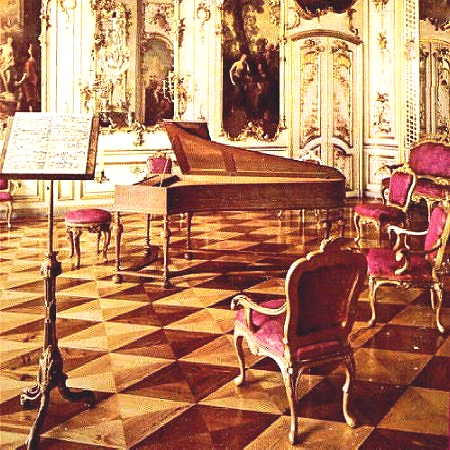
Bach's music is a set of expressions that are constantly looking for a voice to express, and I mean almost literally voice. The pianists we constantly find happiness in a very peculiar dilemma every time we take a score of Bach: Piano or Harpsichord? This situation arises all the authors of the Baroque, as Handel, Scarlatti, Soler, Couperin ... but in the case of Bach we have the choice of instrument is a gentle torment that enjoys a lot.
composers in the above situations occur that reveal the author's original intention when he wrote this or that work. In Scarlatti, for example, have the script shows that the instrument in which the work must be executed is small and soft keys, characteristics of the harpsichord. Couperin is a book entitled L'Art de toucher will clavecin (The art of playing the harpsichord) and the title is not a waste: it is a lengthy treatise on the French harpsichord technique.
Bach's music in the terse and strong German language becomes vague and diffuse. Das Klavier Wohltemperiete , badly translated as "The Well-Tempered Clavier" does not refer to the harpsichord in its title, but all keyboard instruments as Klavier German word meaning "keyboard." But what keyboard? In Bach's time there were organs, harpsichords, virginal, spinet, harpsichord (not the same thing that harpsichord harpsichord). Another example is the title of the last great work of Bach, The Art of Fugue (Die Kunst der Fuge ). It found that the pieces are written with each voice separately and in key soprano, alto, tenor and bass. There is no indication of instrumentation in the score thing is used to play it in any possible combination of solo instruments or with a keyboard instrument.
BWV913
As the humble opinion of your server, the work of JS Bach is written in such a way that transcends the instrument. Music is so powerful that no matter how you listen, you'll always find new forms of expression regardless of the instrument that is played, and stating that you are not suggesting an outrage because it is a clear example of the Chaconne in D minor of the second Partita for solo violin, which is a marvelous transcripts have experienced.
BWV913 is the catalog number of the Toccata in D minor seven series Keyboard Toccatas ranging from BWV916 BWV910 up. In this work I have found many times in the previously described dilemma. The Toccata in D minor, BWV 913, despite its catalog number is probably the oldest of all. Has a more familiar when compared to other Toccatas and therefore it seems more simple in its construction, but this is only in appearance. Forms of 4 sections each separated by starting strongly with a fanciful character introductory movement that unfolds to bring down a number of passages with a beautiful decoration and a return to the force of the initial fantasy figure. So here we could call this first section, "Prelude" of the work. Followed by three movements indications Presto, Adagio, Presto and Allegro, giving the idea of \u200b\u200ba sonata. Rapid movements are very free leak that are closer to the invention and the Intro. The slow movement is characterized by a break ostinato makes its first appearance in the soprano voice on the fourth beat of the movement. Glenn Gould makes magic with this passage.
Here is a recording of that work:
It listens to the force and elegance of the baroque. Elegance. I stopped a bit to think about that word because I was impressed a bit and I think it is a good adjective to describe the baroque spirit. There is an elegant style throughout the book that simply gives me goosebumps.
I invite you to listen to the piece and tell me what you think. Later we will make the painful, but delicious selection of Piano.