Clay (II) Clay
out there a criterion that defines the piano as a percussion instrument because the strings are percutidas for a Matrillé. For some time, the Germans tried to call the word pianoforte Hammerklavier which literally means "hammer keyboard."

Harpsichord by Andreas Ruckers built in 1636
The clavichord is more akin to the lute with the piano in the way it sounds in it: the strings are plucked by a mechanism that is activated by the keyboard in a way very similar to that touch the strings of a harp. The disadvantage of this instrument is that the strings are weak and it is not possible nuances between weak and strong. For this reason the piano was called "Fortepiano" in Italian comes from the words and piano forte: Strong and weak. Later models were called pianoforte instrument to reach the modern Piano the same way that the cello is known simply as Cello.
The Harpsichord come in various shapes and sizes. The most notable, in my opinion, is the inclusion of several keyboards or "manuals ." These made it possible to nuances in the music and give different effects. You could play one or two at a time, turning pegs. Also pins had changed the orientation of the push pins and thereby got different sounds. Just as organs, harpsichords played with the idea of \u200b\u200bthe synthesizer.
 Details of the mechanism of a harpsichord.
The theme of the harpsichord is so interesting and extensive post deserves an own ...
Bach's music transcends the instrument. It had been said but we have not materialized this claim. To do this I invite you to hear the Toccata and Fugue in E minor, BWV914 in harpsichord and later in Piano.
The piece has 4 sections:
An introduction by way of prelude.
A piece in a double fugue, though not strictly a leak.
An adage.
A three-voice fugue.
Piano Steinway Model C.
two manual Harpsichord Hubbart, 1975
The differences are remarkable, let's start dynamics.
The Piano allows nuances between voices, that is, we can give proper emphasis to the voice that carries the theme. In the case of the Toccata, the second section you can hear 2 voices start at the same time. These are the themes of the double fugue and the piano is very easy to emphasize one or the other (of course, say "very easy" is relative).
In the second recording we hear the same piece with harpsichord. The first thing to mention is that the work is half step down. This is because in times of Bach LA3 standard pitch was 415 Hz instead of 440 today day. Instruments made under the specifications of those times were designed to achieve their best sound tuning under these conditions. Therefore respected Baroque pitch on this recording.
almost any chord in harpsichord sounds good without some strappo , which is the execution of the notes of a chord in succession as opposed to joint, as is done today. This was so common in those days that sometimes only the strappo indicated explicitly. The same applies to delays and ornaments. It is common to exaggerations in the duration of the notes, the occasional rubato. For example, are dotted notes play as if they had double dotted. The trills and ornaments such as trills are played with greater impact and faster.
see, is a delightful thing but tortuous decide between the harpsichord and the piano ...
To keep talking about the importance of the music of Bach will see a transcript made by Franz Liszt's a fantasy for organ of the German master.
 Assy General Motors Arlington Plant. All work and no play ...
  In Dallas-Houston route. Embraer 145, FL230
  Houston En route (IAF)-Mexico (MMEX). Boeing 737-700. FL400


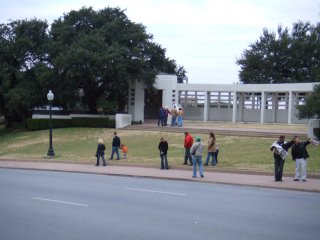 This view will be familiar to those who know something of the JFK case.


