Tuesday, February 14, 2006

Cervix Up And Down With Cycle


In music history there are examples of great mentorship. One of the greatest -in my opinion- is that of Johann Sebastian Bach , who left entire volumes of his works that are devoted to the musical education of his family. There is also the teachings of Albrechstberger to the young Beethoven. However not even a great Bach-admirer like myself can overlook the particular case of Padre Giambattista Martini .

Giovanni Battista Martini (1706-1784) was a catholic priest considered to be one of the greatest counterpointists of the 18th century. " Padre Martini, the great counterpoint teacher of the eighteenth century, has left no really didactic work" , says Knud Jeppesen in his Counterpoint. Padre Martini wrote Essemplare o sia saggio fondamentale prattico di contrappunto fugato dealing with the fine art of fugue writing. This work is a complex one and it is not well-suited for the beginner. One must think of it as a "graduate-course" intended for the student who has completed studies on counterpoint and fugue, only then will one realize that Martini's unconventional teaching method marks the structure of the whole work, a method "neither divided into chapters and paragraphs...nor based on mere precepts" as Willi Reich would put it.
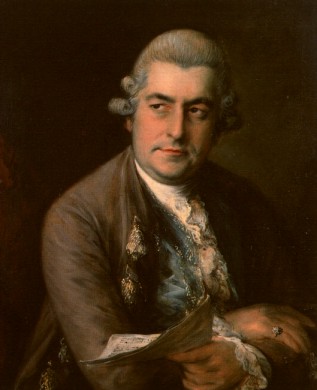

A valuable account of this teachings has survived in the correspondance between Martini and Johann Christian Bach . In his early twenties, J.S. Bach's youngest son went to Bologna to study under Martini. This endeavor was followed by a lively exchange of letters between student and teacher. J.C. Bach wrote to Martini asking for advice many times; he even wrote answers to his own questions for Martini's opinion ocassionally. Johann Christian would travel to London and remained there the rest of his life. He later became known as the "London Bach".


Johann Christian Bach


Another remarkable example of student-teacher relationship is given by Wolfgang Amadeus Mozart . This happened during Mozart's visit to London in 1764-1765. Johann Christian Bach was the most famous musician in England for twenty years, even more famous than his father, the great Johann Sebastian, ever was (old Bach was remembered as "the father of Johann Christian Bach"). J.C. Bach's works caused a lasting impression on young Mozart. Only a few years later, Wolfgang would travel to Bologna to study with Padre Martini. Then he became his direct student.

Wolfgang Amadeus Mozart made a very personal use of counterpoint. The Requiem K626, The unfinished C-Minor Mass, the final movement of the 'Jupiter' symphony are all evidence of it. However, the world of counterpoint is a complex and serious one. The rules one must observe and follow are sometimes too strict: they seem to limit the composer. I have met "accompished" musicians that are hostile towards counterpoint. Counterpoint is being replaced by harmony in most academic programs for this reason.
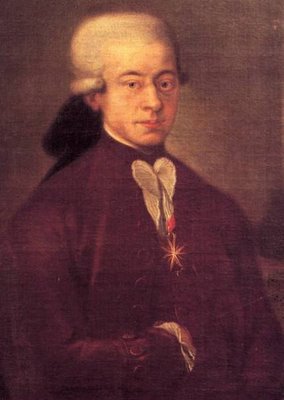


The Bologna Mozart. This painting was commisioned by Martini in 1777, when Wolfgang was 21 years old.


In October 9, 1770, Mozart presented his admission test for the Bologna Accademia dei Filarmonici , a very prestigious institute that remains to our days as one of the finest in the world. The test Mozart was set to solve was to compose a 4-part piece on an anonymous gregorian antiphon, Quaerite Primum Regnum Dei : "Seek ye first the kingdom of God". The results granted Mozart's admission to the Accademia , and even the aknowledgement of the faculty. Wolfgang's father, Leopold later wrote that his son took half an hour to complete what to most took three hours. W.A. Mozart was 14 years old.


Mozart's admission letter, followed by a copy of the piece he wrote.


The object of the test was not to evaluate Mozart's powers as a composer, but to see if he was able to sumbit himself to a more academic form of composition. The Quaerite of Mozart fails to achieve this completely, and for this reason his teacher, Padre Martini, wrote a different example to ilustrate his pupil on the correct solution to the excercise. This is where things get interesting.

Martini's version does not correct Mozart's. Martini instead choose the best ideas from his pupil's work and used them as thematic material for an entirely new example. Martini's version is related to Mozart's in almost every measure yet it stands as a finished masterpiece against the much less polished though amazing work of the fourteen-year old Mozart.

One could speak volumes of the comparison between both excerises, like the omission of Mozart's second subject and the use of perfect cadences to confirm the tonality of F in the eleventh measure and the tonality of D at the end. However, I would like to emphasize the fact that Martini acknowledges the powers of his pupil. With only one exception, I haven't met a professor capable of doing this. Thesis and dissertation supervisors are no different. Most people will only criticize destructively thinking that they are constructively doing so.

Padre Martini's teachings came as revelations to Mozart. As in the case with J.C. Bach, both master and disciple sustained a lenghty correspondance throught their lives. Martini's teachings were the foundation on which Mozart built fantastic works of art, filled with the Most impressive and beautiful complexity.


Click here to download a copy of the score for Mozart's version. (KV86)

Click here to download a copy of Martini's version.


Comments Welcome!

Wednesday, February 8, 2006

Mini Cooper Automatic Transmission

Tricks (I)


Someone anonymous left a comment about my observation on the car's oil filter. The comment gave me much laughter, for in his mischief is sensed something very true: then why#&%$! oil filter they put the cars?

The answer can be taken as my No. 1 tip for improving the efficiency of the car engine.

The oil is to lubricate the moving engine parts and prevent wear and frictional heating of the same. The more moving parts that require lubrication are the pistons, connecting rods and crankshafts. This lubrication is supplied to pump oil through a pump-light-extracting this fluid from the sump (oil pan "in English). By sucking crankcase oil, the pump sends the oil to a filter that removes wastes and impurities. Then the oil is sprayed under pressure on moving parts, lubricating. The oil then drips back into the crankcase, where the cycle begins again. Below you can see an image that illustrates how a 4-stroke (Otto). In the background we can see the oil container.


Having given this explanation of how express lubrication in the engine of the car now proceed to say this:

The engine works better without the oil filter.

Many people have told me that this is not possible, how can I know more than the engineers in Detroit. The thing is very simple: the oil filter is an insurance against people who do not change the engine oil every 2 months or every 5,000 km

Over the years, and the introduction of fuel injection, combustion within the engine has become more "clean", so it leaves less waste. We also need the engine blocks are aluminum, which is less prone to chipping.

manufacturers recommend changing engine oil every 5,000 km ALMOST NO ONE DOES THIS. The automotive industry's response is to continue using oil filters for user safety negligence. Now, to change the engine oil is a simple thing ... what happens is that the apathy is big.

Imagine this: an oil filter clogged (that the user has traveled 10.000 miles in the car without replacing the engine oil) hinders cost of engine oil. Lubrication is not adequate and the engine warms up unnecessarily. The heat causes the oil to burn inside the engine, the smoking machine and causing the oil level drops. The latter in turn leads to more warming. Warming = wear.

I've seen cars with 100,000 miles on the odometer, suffered greatly from engine wear. Instead I have seen others with 160.000 Km to which they have removed the motor oil filter which ronrronea as a kitten.

Does it work ?....

Yes of course it works. Without oil filter, the engine is best supplied by oil and as a logical consequence is better lubricated. A well lubricated engine uses less energy to operate. And whence comes the energy created using the engine? For providing combustion gas. Less energy used = gasoline saved.

Exactly how much gasoline we talk? That if I take off guard. I do not know. What I can say is that during a traffic jam the engine work less "stressed", which saves 2% -3% of fuel. The benefits of this are not only fuel, but the fact that the engine "smokes" less. It is beneficial for the car that the engine is as clean as possible.

recommend " to undo the oil filter in your car? If you are going to change engine oil every 5,000 miles with eager punctuality, Yes!

But for those who do not want to spend on the frequent oil changes or do not know how to change the oil the car would not recommend that you dispose of FILTER.


Inglés Spoken.

punctus will soon punctus against articles in English ...