In interpreting a leak at times one is left with a feeling I can only describe as a close to madness ( the voices, the voices ... Where do the voices? ). The interpretation and analysis of a leak is thing that separates the mediocre artists, so it is common for beginners in the art-science that is music to flee from this form of expression.
In my copy of Abhandlungen von der Fuge, the preface says that the author, Friedrich Wilhelm Marpurg , said: "Being a good musician and not have the highest respect for the old Bach is a serious contradiction . I can not agree more with that comment. The music is Bach as religion because its founder, said Schumann.
pretentious would want to describe the theoretical concepts of counterpoint to make the existence of a leak. For now suffice to say that a leak is a composition in which the parts or voices are imitated in such a way that seems to escape the pursuing something. There is a rigid framework to build a leak. Think otherwise those who have not mastered the art of counterpoint, those who are better melodic contrapuntalists.
I have many friends who are fans of the Jazz. To them I say that counterpoint is a fundamental part of the Jazz, it is what allows musicians to improvise creative and surprising ways on a given topic. Music course is relatively new, but the Jazz is out of the merger of the Blues with the church modes, which though most remember the kinds of harmony, have deeper applications in those of punctus against punctus.
Well, I talked of the dialogues that sustain the voices in a fugue. Using the word seems dialogue successful, but it falls short. The dialogue of which I speak goes beyond small talk between voices.
The Fugue for organ in A minor BWV543, Bach includes a fairly long-section, where the voices talk to each other in a special way. Try to explain what I mean by some aid in the score.

In this fragment of the leak I put in red the topic-or subject-and blue to the voice that answers the subject (hey, it's not a countersubject). In the two bars that present the voice can be blue swap places with the word red. This is the invertible counterpoint, where the grave may become acute and vice versa. The effect is something like a tennis game: one serves and the other responds. One thing that is highlighted in this passage is that this development takes place in the dominant key (Yes, the piece is in A minor). This creates a tension throughout the passage, where does this?, Where did it solve? The conclusion of this train of tensions is the return to the tonic.
Here I put more of the passage, with the subject (or their fragments) in red.
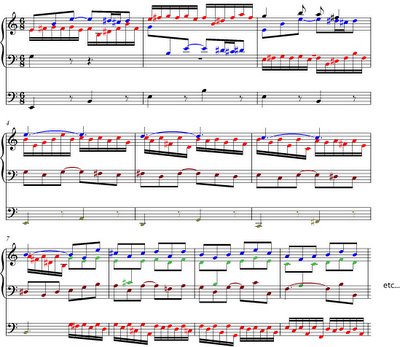
In this small mosaic of colors we see red notes jump among the voices.
This passage is something that comes to improving the quality of "leakage": The minute you finish a piece of the subject, it has already jumped to another voice. That gives the impression that the voices are really scampering along the score. This is considered a stretta leak. Stretta (narrow) is the part of the flight where a voice is exposed to the track and stopped right in the middle of his presentation by another voice that exposes the same subject, which in turn is interrupted in the same way. This process takes many voices are in flight. In this case we have a stretta harsh, because the issue was not discussed in their entirety. Write a leak that has a stretta required to compose a suitable subject to the procedure just described. Bach in his greatness humble teaches us a lesson: not that difficult a subject you mean you can not do stretta. The result of this exercise - although not a stretta-get equally stunning effect.
Now I get a recording of that particular passage, played on a Roland digital piano.
And you can not miss a full flight recording:
Fugue in A minor. BWV543


0 comments:
Post a Comment